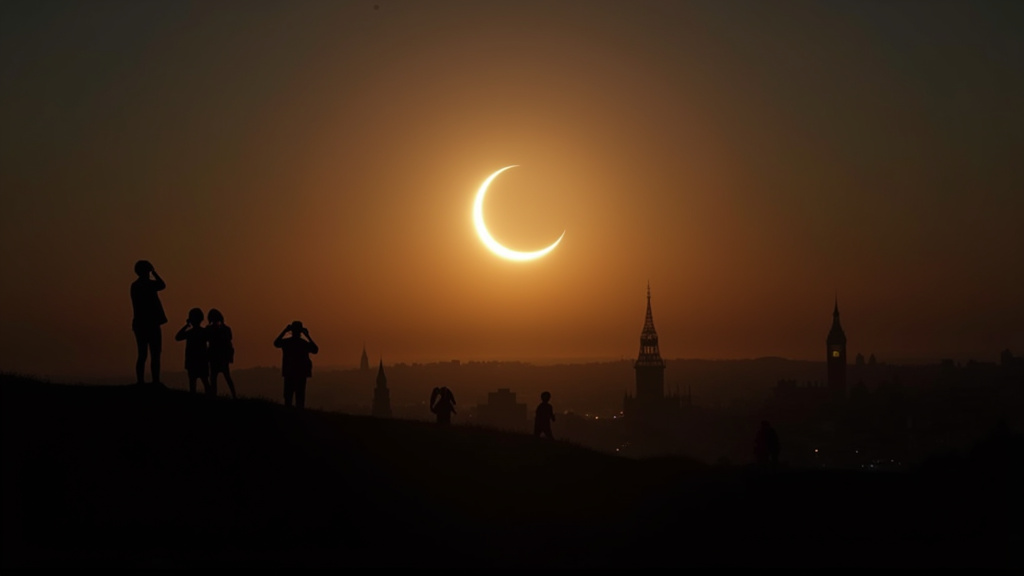
London is set to experience a breathtaking celestial phenomenon this evening, August 12, as a deep partial solar eclipse sweeps across the city. Astronomers and skywatchers are preparing for a significant event, with the moon projected to obscure up to 90% of the sun’s disk when viewed from the capital. This event, which begins at 6:17 PM and reaches its maximum coverage at 7:12 PM, serves as a poignant reminder of the rare, rhythmic beauty of our solar system and the importance of professional astronomical observation methods.
The Celestial Mechanics of the Deep Partial Eclipse
At 6:17 PM, the moon will begin its transit across the solar disk, marking the start of a deep partial eclipse. Unlike a total solar eclipse, where the moon completely covers the sun, this event will see the sun reduced to a thin, brilliant crescent. The physics behind this occurrence involves the precise alignment of the Sun, Moon, and Earth—a syzygy that demands perfect orbital positioning. For Londoners, the 90% coverage at 7:12 PM represents a significant drop in solar luminosity, which will create a noticeable, eerie twilight effect across the city. This dramatic shift in light intensity is a rare occurrence for the UK, and observers can expect a perceptible drop in temperature as the solar radiation reaching the ground diminishes sharply during the peak.
Prime Viewing Locations in the City
While the eclipse will be visible from any location with an unobstructed view of the western horizon, certain areas in London offer a more immersive experience. High-altitude vantage points, such as the top of Primrose Hill or the viewing galleries of skyscrapers like The Shard, provide excellent sightlines for watching the moon’s progress. However, urban stargazers should prioritize locations with a clear western horizon, as the eclipse will take place later in the evening as the sun begins its descent. Parks with expansive, low-altitude views, such as Greenwich Park, near the historic Royal Observatory, are likely to be hubs for local astronomy enthusiasts. Regardless of the location, the primary factor for a successful viewing experience is minimizing light pollution and ensuring a clear, cloud-free view of the horizon.
The Critical Importance of Safety and ISO 12312-2
Viewing the sun directly, even during a 90% eclipse, poses a significant risk of permanent retinal damage. The human eye cannot sense ultraviolet and infrared radiation, which can burn the retina without causing immediate pain. To view the eclipse safely, you must use specialized solar filters that meet the international standard ISO 12312-2. These filters are thousands of times darker than standard sunglasses and are specifically designed to block harmful solar radiation. If you are using optical aids like telescopes or binoculars, the solar filter MUST be placed in front of the objective lens—never behind the eyepiece—to prevent the concentrated solar energy from shattering the glass and causing immediate, severe injury to the observer. If you do not have certified eclipse glasses, consider the ‘pinhole projection’ method, where light is projected through a small hole in a card onto a surface behind it, allowing you to view the crescent sun safely without looking up.
Infrastructure and the Urban Energy Grid
One of the most fascinating secondary angles of a deep partial eclipse is the impact on modern infrastructure. As the solar disk is covered, the total output of solar farms across the UK will experience a rapid, massive decline. This presents a unique challenge for National Grid ESO, the organization responsible for balancing electricity supply and demand. Unlike traditional generation sources, solar power fluctuates based on cloud cover and atmospheric conditions. A sudden 90% reduction in solar input requires rapid adjustments from backup power plants, including gas and hydro-pumped storage, to compensate for the lost wattage. Analyzing the grid’s response during this 7:12 PM peak provides invaluable data for how energy systems can adapt to a more renewable-heavy grid in the future.
Historical Context and Modern Perception
The UK has a long history of fascination with solar eclipses, though they are notoriously infrequent in terms of visibility from major urban centers. The last comparable event, the 1999 total solar eclipse, left a lasting cultural impact on the British public, cementing the eclipse as a ‘bucket list’ astronomical event. Today, social media and digital tracking tools have transformed how we experience these events. Rather than localized, isolated viewing, the eclipse acts as a collective social experience. The event also offers a window into how historical societies viewed such phenomena as omens or supernatural occurrences, contrasting sharply with our modern, data-driven understanding provided by organizations like the Royal Astronomical Society. This duality—the ancient wonder paired with modern precision—is what makes the August 12 eclipse such a compelling moment for the city.
FAQ: People Also Ask
Will the entire city go dark at 7:12 PM?
No. While 90% of the sun will be covered, the remaining 10% is still intense enough to provide significant ambient light. It will not become night-time, but you will notice a distinct, ‘unnatural’ twilight or a dimming of the sky, similar to the light during a heavy, overcast day.
Can I use my regular sunglasses to watch the eclipse?
Absolutely not. Standard sunglasses are insufficient protection against solar radiation. You must use ISO 12312-2 certified solar eclipse glasses. Sunglasses provide zero protection against the infrared light that causes retinal burning.
What if it is cloudy in London during the eclipse?
If there is heavy cloud cover, you will likely not see the eclipse visually. However, the drop in light and temperature will still be measurable. Many local science centers and websites will host live streams from regions with clearer skies, allowing you to follow the event digitally.
Is it safe to take photos with my smartphone?
Only if you place an ISO-certified solar filter over your smartphone’s lens. Pointing a smartphone camera directly at the sun during an eclipse can damage the device’s sensor and, more importantly, put your eyes at risk if you try to align the camera screen while looking near the sun.