London – A powerful Banksy mural that appeared overnight on the exterior of the Royal Courts of Justice in London, depicting a judge striking a protester with a gavel, has been removed by authorities. The artwork, which was quickly covered up after its appearance on September 8th, has fueled discussions about free speech and artistic commentary on the justice system.
The Striking Image and its Context
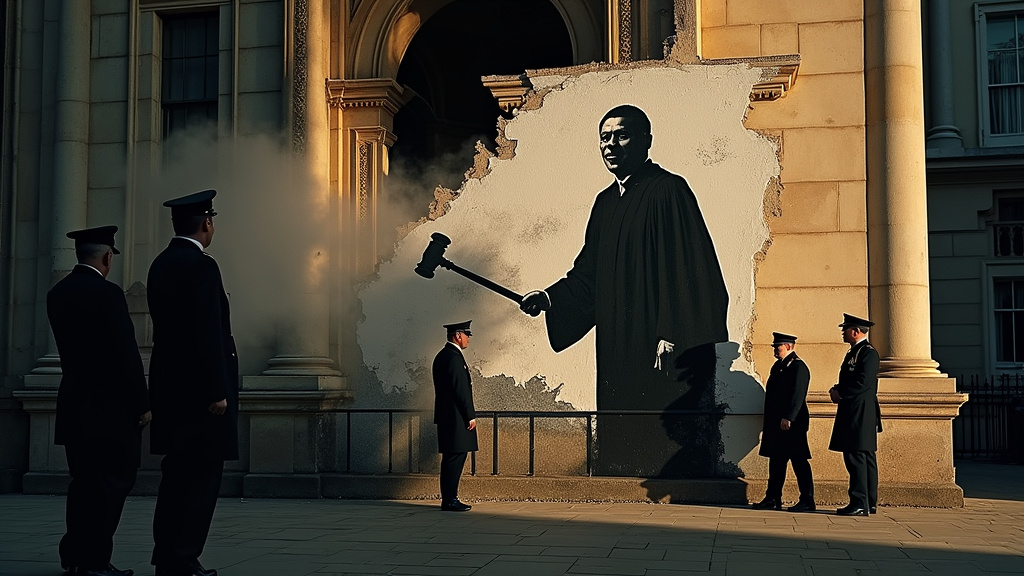
The controversial mural, instantly recognizable as the work of the elusive street artist Banksy, showed a judge in traditional wig and gown wielding a gavel over a fallen protester holding a blood-splattered placard. Banksy confirmed his authorship via an Instagram post, captioned simply, “Royal Courts Of Justice. London.”
The artwork is widely interpreted as a direct response to the recent crackdown on demonstrations supporting the pro-Palestinian group Palestine Action. The group was officially banned by the British government in July under anti-terrorism legislation following incidents where members allegedly damaged military aircraft. In the days leading up to the mural’s appearance, nearly 900 protesters were arrested at a demonstration in London challenging this ban. Activists and supporters, including the group Defend Our Juries, which organized the protest, stated that Banksy’s piece “powerfully depicts the brutality unleashed” by the government’s actions and the broader implications for civil liberties.
Official Justification for Removal
The decision to remove the mural was based on the heritage status of the Royal Courts of Justice. The 143-year-old building is a Grade I listed structure, meaning it holds the highest level of historical protection in England. A spokesperson for HM Courts and Tribunals Service (HMCTS) confirmed the removal, stating, “The Royal Courts of Justice is a listed building and HMCTS are obliged to maintain its original character.” This legal obligation to preserve the building’s historical integrity was cited as the primary reason for the artwork’s dismantling.
Outrage and Debate Over Censorship
The swift covering and subsequent removal of the artwork did not go unnoticed, drawing immediate criticism and sparking an online debate about censorship. Many social media users and commentators felt that the authorities’ rapid response proved Banksy’s point about the suppression of dissent. Tech mogul Elon Musk weighed in on the controversy, agreeing with a post that suggested the covering of the mural by the courts was an act of censorship that validated the artwork’s message. He commented, “The more they try to cover it up, the more it will appear,” referencing the Streisand effect.
Activists expressed dismay, with one individual quoted as saying, “They censored a piece of art that was literally mocking censorship… and by doing so, they proved his point in real time.” The Metropolitan Police had reportedly launched an investigation into the mural as potential criminal damage, a process that could have potentially forced the anonymous artist to reveal their identity if charges were pursued.
A Broader Political Commentary
Banksy, known for his politically charged and often anti-authoritarian street art, has frequently addressed issues concerning protest, human rights, and governmental policies. His work in London is seen as a continuation of this trend, drawing attention to the tension between state power, the judiciary, and the right to protest, particularly in the context of foreign policy and activism. The artwork’s appearance and subsequent removal highlight the ongoing tension surrounding free speech in the UK and the power of art to provoke dialogue on contentious issues.
The mural, which was covered with black plastic sheeting and metal barriers shortly after its discovery, was guarded by security personnel. While the official justification for its removal is preservation of a historic building, the incident has been widely featured in news outlets globally, amplifying the message Banksy intended to convey and keeping the conversation about civil liberties at the forefront. The removal itself has become a focal point of the narrative, underscoring the significant cultural and political impact Banksy’s interventions continue to have.