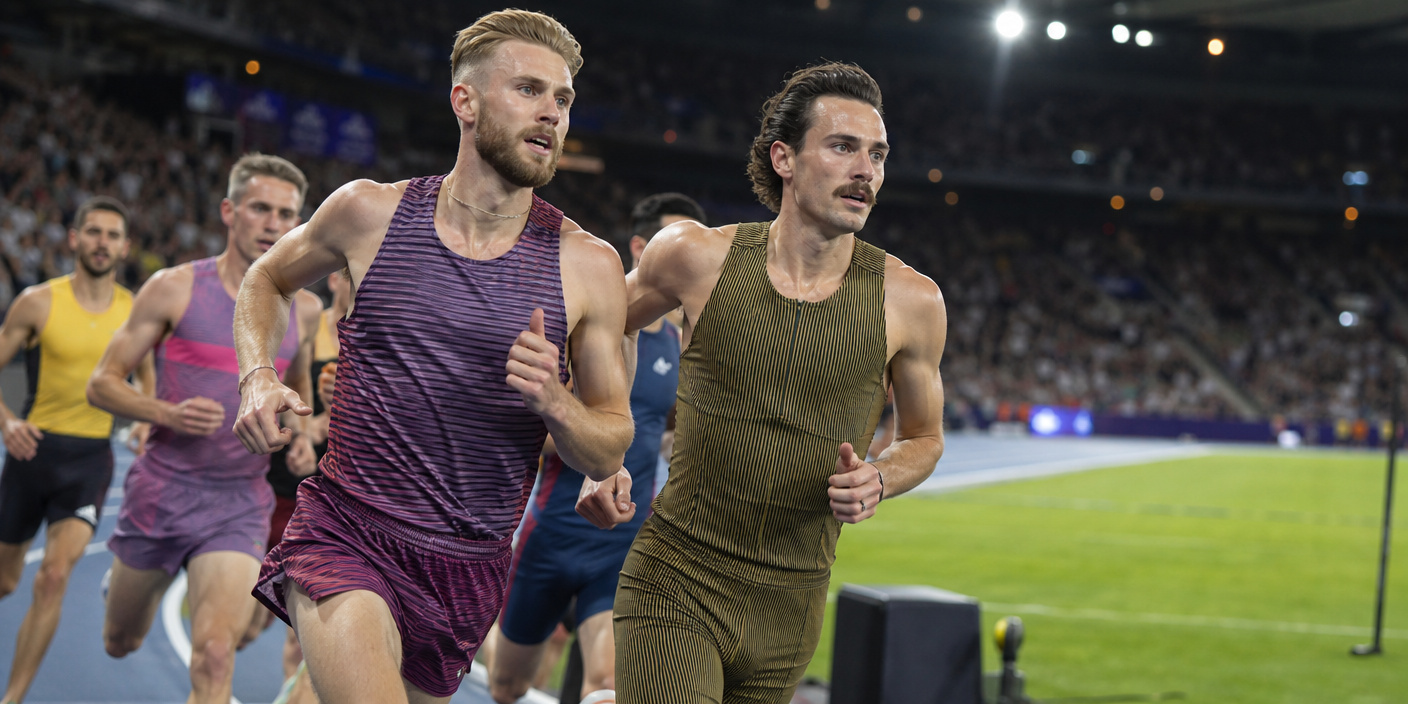
As the Glasgow 2026 Commonwealth Games reach their penultimate day, the focus of the athletics world shifts entirely to a single, high-stakes event. Saturday, 1 August, promises to be the definitive moment of the games as the men’s mile takes center stage. The scheduled showdown between Scotland’s own tactical titan, Josh Kerr, and the blistering young Australian prodigy, Cameron Myers, represents more than just a race; it is a collision of eras and philosophies that has captivated the global running community.
The Glasgow Mile: Defining a Rivalry
A Masterclass in Tactical Racing
Josh Kerr, the reigning world champion, enters the Glasgow 2026 Games not just as a competitor, but as a standard-bearer for British middle-distance running. Known for his unflappable psychological game and an ability to dismantle opponents in the final 200 meters, Kerr has become the runner that everyone else fears. His approach to the mile is often described as a chess match played at 15 miles per hour. By utilizing the home-field advantage of the Glasgow track, Kerr is expected to leverage the vocal support of the Scottish crowd to elevate his performance during the final lap. For Kerr, this race is about legacy; it is about cementing his status in front of the people who saw his early development in the Scottish athletics system.
However, the challenge from Cameron Myers is mathematically significant. Myers, the Australian sensation who has been breaking age-group records with frightening regularity, brings a different energy to the track. While Kerr is the surgeon, Myers is the storm. His trajectory over the last twenty-four months has been unparalleled, transitioning from a junior prodigy to a legitimate threat on the senior world stage. Analysts suggest that Myers possesses a raw aerobic capacity that could force Kerr to abandon his usual sit-and-kick tactics earlier than he would prefer. If Myers can drag the pace into the 3:48 or 3:49 range, the race becomes a contest of pure endurance rather than a tactical brawl, which is exactly the terrain Myers thrives upon.
The Anatomy of the August 1 Showdown
The date of August 1 holds specific significance in the Glasgow 2026 schedule. By day nine, the fatigue of a multi-day championship will have set in for the field. The sprinters will have finished their heats, and the endurance athletes will be nearing the end of their recovery cycles. The scheduling of the men’s mile as a marquee event on this Saturday evening is a deliberate attempt by organizers to capitalize on the prime-time audience, ensuring the maximum possible eyes are fixed on the track.
From a technical perspective, the Glasgow track surface is being prepared for speed. Observers note that the density of the track material has been optimized for energy return, a factor that will benefit the younger, springier legs of Myers. Conversely, the banked curves of the stadium have been designed with long-distance flow in mind, potentially favoring the slightly wider, more efficient stride of Kerr. The interplay between these technical variables will determine whether the race is won through pure front-running speed or a strategic maneuver on the final bend.
Secondary Angles: Beyond the Gold
While the Kerr-Myers rivalry dominates the narrative, three secondary factors will influence the outcome of the Glasgow Mile.
First is the economic and cultural impact of the Games on the host city. Glasgow’s successful pivot to a scaled-down, sustainable Commonwealth Games model is under intense scrutiny. A successful, high-profile race like this provides the ‘headline moment’ required to justify the expenditure and logistical restructuring that defined the 2026 Games’ planning phase. The race serves as a litmus test for the city’s ability to host premium athletic spectacles efficiently.
Second, we must consider the evolution of sports science in middle-distance training. The preparation regimens for both athletes have utilized high-altitude simulation chambers and bio-feedback data that were not standard a decade ago. We are seeing a shift toward data-driven pacing, where the athletes will likely know their lactate threshold thresholds with 99% accuracy before the starting gun even fires. This race will prove whether human intuition—the instinct to move at the right moment—can still outpace the algorithmic predictions of coaching staffs.
Third, the role of national pride cannot be overstated. For Kerr, running in Scotland is a career-defining opportunity. There is a distinct ‘host nation pressure’ that can either act as a catalyst or a weight. History is littered with examples of home-town heroes who faltered under the weight of expectation. If Kerr can withstand the emotional drain of competing before a roaring home crowd, he validates the Scottish Athletics infrastructure. If he falls, it creates a vacuum of leadership that the next generation of runners, potentially inspired by this very race, will look to fill.
As the stadium lights dim and the crowd rises on that Saturday in August, the world will not just be watching two men run four laps. They will be watching the future of the mile, the tactical evolution of the sport, and the legacy of the Glasgow 2026 Games written in real-time. Whether it ends in a photo finish or a dominant kick, the rivalry between Josh Kerr and Cameron Myers is the storyline that defines this Olympiad-adjacent event.
FAQ: People Also Ask
Q: What time is the Men’s Mile final scheduled for on August 1?
A: The Men’s Mile final is the centerpiece of the evening session on Saturday, August 1, 2026, typically scheduled during the primetime window between 7:30 PM and 9:00 PM local Glasgow time, pending final broadcasting adjustments.
Q: Where can I watch the Josh Kerr vs. Cameron Myers race?
A: The event will be broadcast globally through official Commonwealth Games rights holders, including the BBC in the United Kingdom and various regional sports networks across the Commonwealth, with streaming options available on official event platforms.
Q: Is Cameron Myers eligible to compete for the Commonwealth Games?
A: Yes, Cameron Myers competes for Australia, which is a key member nation of the Commonwealth Games Federation. His eligibility is confirmed through standard athletic qualification processes and international sporting rankings.
Q: How does the Glasgow 2026 Games format differ from previous years?
A: The 2026 Games in Glasgow have adopted a leaner, more sustainable model, focusing on existing infrastructure and a smaller footprint, concentrating athletics in key venues like the stadium being used for this historic mile showdown.