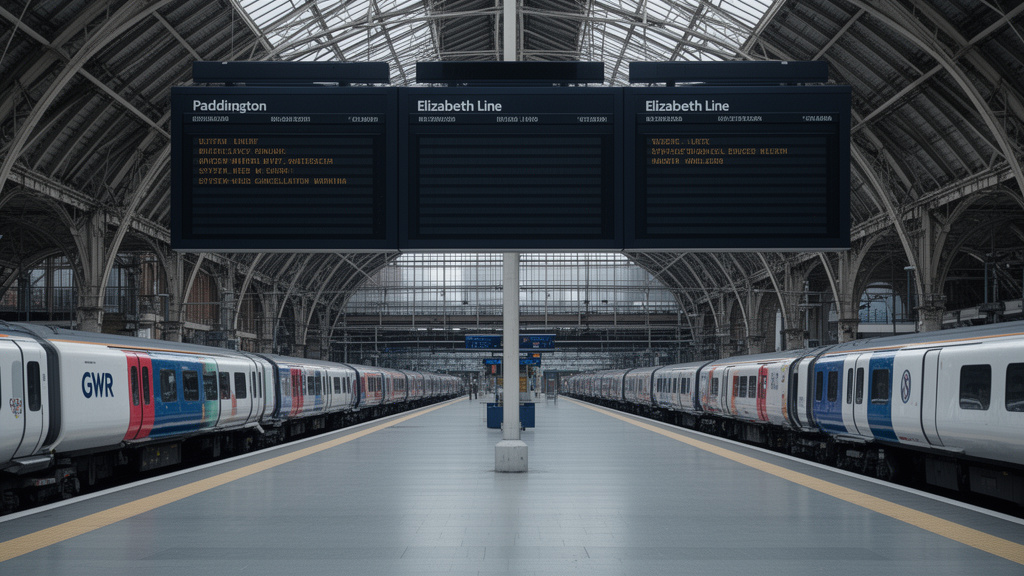
A fire at London Paddington has led to a catastrophic failure of the electrical supply system, paralyzing one of the United Kingdom’s most vital transport hubs. The incident, which occurred amidst peak operational hours, has resulted in the total cancellation of services to Heathrow Airport and Reading, leaving thousands of commuters and international travelers stranded. The disruption highlights the severe vulnerability of centralized infrastructure in the face of localized incidents, causing a cascading series of delays that have rippled across the Great Western Main Line and the Elizabeth Line.
Key Highlights
- Infrastructure Failure: A localized fire damaged critical electrical equipment, leading to an immediate power failure for rail lines operating out of Paddington.
- Heathrow Paralysis: Services to Heathrow Airport, including the Heathrow Express and Elizabeth Line, have been suspended, affecting international travel logistics.
- Widespread Disruption: Rail operators, including Great Western Railway (GWR), have reported significant cancellations and delays affecting services as far as Reading.
- Operational Fallout: Network Rail engineers are working under high-pressure conditions to restore power, though the timeline for full recovery remains fluid.
The Anatomy of a Rail Network Collapse
The incident at London Paddington serves as a stark reminder of the delicate balance required to maintain the UK’s high-speed rail operations. When the fire initially broke out, it did not merely cause physical damage; it severed the electrical conduit that powers the signaling and traction systems upon which the Great Western Main Line (GWML) depends. In modern rail infrastructure, the electrical systems are often integrated with signaling controls; thus, a fire that damages the power supply invariably results in a ‘fail-safe’ shutdown of the network to prevent catastrophic derailments or signaling errors.
The Ripple Effect on Commuters
For the modern commuter, the impact is immediate and visceral. Paddington station, which serves as the London terminus for the GWR network and a critical node for the Elizabeth Line, saw thousands of passengers stranded within minutes. The suspension of services to Reading—a major commuter artery—effectively disconnected West London and the Thames Valley from the capital.
Economic analysts note that the impact on Heathrow Airport traffic is particularly acute. As one of the world’s busiest international gateways, Heathrow relies on seamless rail connectivity to manage passenger flow. The sudden absence of the Heathrow Express and the cross-London capacity of the Elizabeth Line forces thousands of travelers onto alternative, already overburdened bus and taxi services, compounding the congestion across the city’s surface-level roads.
Infrastructure Vulnerability and Modernization
The fragility exposed by this fire raises difficult questions regarding the redundancy of the UK’s rail infrastructure. The centralized reliance on the Paddington terminal as the primary power distribution point for this section of the network means that any localized failure can escalate into a national-level disruption. Engineers argue that while modern rail systems incorporate sophisticated fail-safes, the physical integration of electrical, signaling, and track-side components makes the network susceptible to ‘single point of failure’ scenarios.
This event is likely to reignite the debate within the Department for Transport regarding the necessity of a more decentralized power grid for rail infrastructure. While the current system is designed to be safe, the economic cost of such paralysis—measured in thousands of missed flights, delayed business meetings, and productivity losses—presents a compelling argument for investment in resilient, redundant secondary electrical systems.
The Recovery Operation
Restoring power to a live rail environment is not a simple matter of flipping a switch. Network Rail teams must first ensure the fire site is safe, then conduct forensic checks on the electrical wiring to ensure no short-circuits remain that could endanger passengers or personnel once energized. Following that, signaling systems must be rebooted and synchronized. This process is time-consuming and explains the prolonged uncertainty regarding service restoration times. Operators are currently advising passengers to check specific journey planners and look for alternative routes, though the sheer volume of affected passengers has effectively overwhelmed all available contingencies.
Economic and Social Impact
Beyond the inconvenience to daily commuters, the incident underscores the interconnected nature of the London economy. Large-scale infrastructure failures of this nature act as a tax on efficiency. When a transit hub of Paddington’s stature fails, the economic productivity of thousands of businesses in the tech and legal corridors of the Thames Valley drops significantly. Furthermore, the reputational cost to London as a global transit hub is not insignificant, particularly when international arrivals find themselves effectively marooned at the airport with no rail link to the city center.
FAQ: People Also Ask
Q: How can passengers claim compensation for these delays?
A: Passengers affected by these cancellations are entitled to claim under the ‘Delay Repay’ scheme offered by the relevant train operating company (e.g., GWR or Elizabeth Line). It is essential to keep all tickets and travel records to support your claim.
Q: When is the rail network expected to return to normal?
A: Restoration timelines are dependent on the specific repair requirements identified by Network Rail. Passengers are strongly advised to check official operator websites and social media channels for real-time updates as the situation evolves.
Q: Why was the Heathrow Express affected?
A: The Heathrow Express operates on the same Great Western Main Line tracks that were impacted by the power failure at Paddington. Because the electricity supply is shared, the service cannot run until the core power issue is resolved and safety checks are completed.