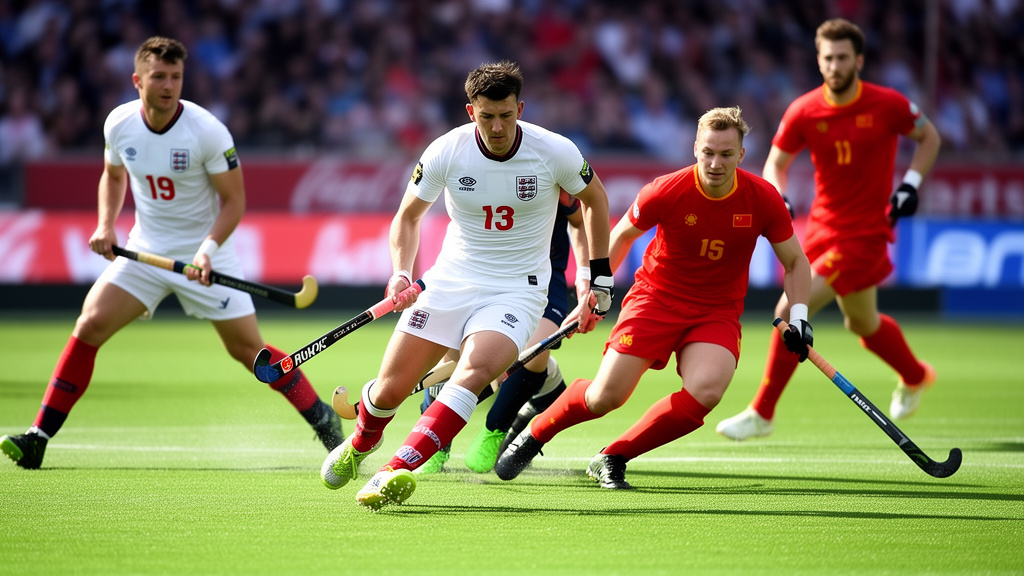
The England women’s hockey team enters today’s high-stakes encounter against China with the clearest of objectives: a victory will secure their path to the 2026 World Cup. Sitting on the precipice of tournament qualification, the squad needs only a regulation-time win to accumulate the crucial six points required to cement their standing in the group. This match is not merely another fixture in the calendar; it is a definitive test of the program’s technical evolution and tactical resilience on the international stage.
Key Highlights
- The Qualification Mandate: England needs a decisive victory against China to reach the six-point threshold required to guarantee their progression to the 2026 FIH World Cup.
- The Tactical Chess Match: The coaching staff has prioritized defensive stability and high-transition offense to counter China’s structured counter-attacking style.
- Tournament Momentum: This match represents the culmination of a rigorous qualifying cycle, testing the squad’s depth and psychological readiness for elite-level hockey.
The Road to 2026: Strategic Implications of the China Showdown
The landscape of international field hockey is shifting, and the current qualification cycle for the 2026 FIH World Cup has proven to be one of the most demanding in recent memory. For the England women’s hockey team, the journey to this match against China is a reflection of the team’s broader ambitions under the current high-performance framework. The team, which often operates as a core component of the Great Britain squad in Olympic cycles, must now assert its individual dominance on the pitch, navigating a complex points system that rewards consistency over sporadic brilliance.
The Mathematics of the Qualification Pathway
Understanding the stakes requires looking beyond the scoreline. The International Hockey Federation (FIH) has implemented a qualification structure that places a premium on head-to-head performance during these continental crossovers. With the current standings, a draw or a loss would create a precarious scenario, potentially forcing the team into a secondary qualification pathway that adds unnecessary strain to the schedule.
By securing three points today, England effectively eliminates the variable of goal difference—a notorious tie-breaker that has haunted teams in previous campaigns. The math is simple, but the application is complex. The coaching staff has been vocal about the importance of controlling the tempo. In modern international hockey, controlling the midfield through a disciplined press is the surest way to prevent the opposition from establishing a rhythm. The English squad has spent the last week refining their high-press strategy, aiming to force turnovers in the opposition’s defensive quarter, a tactic that yielded significant success in their preliminary matches.
Scouting the Chinese Opposition: A Tactical Analysis
China’s women’s hockey program has undergone a significant transformation in the last two years. No longer relying solely on deep-defensive blocks, the Chinese team has adopted a more expansive, speed-based transition game. They are particularly dangerous on the counter-attack, utilizing long aerial passes to bypass midfield traffic and catch opponents off-balance.
England’s tactical preparation has heavily focused on the ‘transition defense’ phase. This refers to the critical three-to-five seconds immediately following a turnover in the attacking third. If England commits too many players forward without cover, China’s speed on the wings will punish them. The defensive line, anchored by veteran leadership, has been tasked with maintaining a ‘compact shell’ to force play into the channels where England’s defensive structure is strongest. This analytical approach to the game highlights the evolution of England Hockey, which now utilizes real-time data analytics to map opponent tendencies during the match.
The Psychological Aspect: Handling Elite-Level Pressure
Beyond the tactics and the data, this match will be decided by psychological fortitude. Tournament hockey is a pressure cooker. The difference between a team that qualifies and a team that falters often comes down to their ability to execute set-piece routines when the game is tied in the final quarter.
England has invested heavily in ‘pressure training,’ simulating high-intensity scenarios where the team is down by a goal with only minutes remaining. This mental conditioning is vital. The players have spoken in interviews about the need to remain ‘process-driven’ rather than ‘outcome-driven.’ By focusing on the next pass, the next tackle, and the next run, they hope to insulate themselves from the weight of the World Cup qualification hanging in the balance. The leadership group has emphasized that the 2026 World Cup is a long-term goal, and that qualification is just the first step in a larger mission to reclaim a spot on the Olympic podium.
Future Implications and Program Development
Qualification for 2026 is more than just an entry into a tournament; it is a financial and developmental lifeline for the national program. Securing a spot early in the cycle allows for long-term planning, including the ability to schedule high-quality friendlies against other qualified nations in the lead-up to the World Cup. It also ensures consistent funding and support from governing bodies, which is contingent on maintaining top-tier performance levels.
Furthermore, successfully navigating this qualification cycle will serve as a bellwether for the ‘new generation’ of English talent. The current squad is a blend of seasoned veterans who have competed at multiple World Cups and younger, hungry players looking to establish themselves as permanent fixtures in the starting eleven. Should they secure the win today, it will signal that the transition between these two cohorts is progressing successfully, setting a strong foundation for the remainder of the Olympic and World Cup cycle.
In conclusion, while the focus is entirely on the 60 minutes of play against China, the broader context is one of a program in transition, seeking to solidify its identity as a perennial world-class competitor. The fans, the coaching staff, and the governing bodies are all looking for a clinical, professional performance that mirrors the team’s ambition. Qualification is the standard, and today is the day England must meet it.
FAQ: People Also Ask
Q: What happens if England loses to China today?
A: While a loss would be a setback, it does not immediately eliminate England from the 2026 World Cup. However, it would force them into a more complicated qualification pathway, relying on other match results and potentially requiring participation in a secondary qualification tournament to secure a spot.
Q: Who are the key players to watch for England in this match?
A: Tactical focus usually revolves around the defensive midfield anchor who dictates the pace, and the primary drag-flicker on penalty corners. Keep an eye on the defensive structure transitions, as that will be where the game is won or lost.
Q: Is the 2026 World Cup qualification format different from previous years?
A: Yes, the FIH has adjusted the qualification pathways to emphasize continental consistency, making matches like this one against China more consequential for direct entry rather than relying on global qualifying tournaments.
Q: How has the England vs. China rivalry developed in recent years?
A: The rivalry has grown significantly as both teams have modernized their styles. China’s shift to a high-speed transition game has forced England to become more tactically disciplined, leading to highly competitive and strategic matchups.