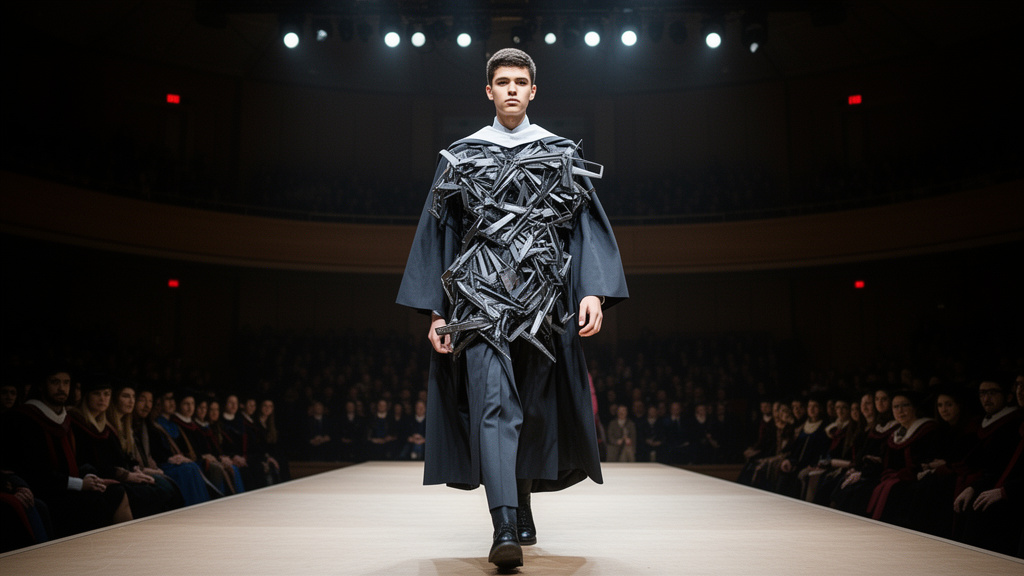
Graduation ceremonies at the University of the Arts London (UAL) have evolved into a viral sensation, fundamentally redefining what it means to cross the stage. While traditional commencements are often characterized by uniform robes and stiff formality, the graduating classes at UAL—a federation of six renowned colleges including Central Saint Martins and the London College of Fashion—have transformed these academic milestones into immersive, avant-garde fashion runways. Clips of students donning elaborate, structural, and meticulously crafted garments while accepting their diplomas have garnered millions of views across TikTok and Instagram, positioning these ceremonies as some of the most anticipated fashion events of the London calendar.
Key Highlights
- The Runway Effect: Students are increasingly treating the graduation stage as a professional catwalk, utilizing the ceremony as a platform to display their final design work and personal creative identity.
- Institutional Pedigree: The phenomenon is deeply rooted in the culture of UAL colleges, particularly Central Saint Martins, where students are trained to treat every public moment as a professional portfolio opportunity.
- Viral Reach: The shift from private academic ritual to public performance art has significantly amplified the social media footprint of UAL, turning graduation clips into trending content with massive engagement.
- Defining Professionalism: The trend signals a changing landscape in the creative industries, where personal branding, distinct aesthetic identity, and digital visibility are as critical as the degree itself.
The Graduation Catwalk: A New Era of Performance
For many students at the University of the Arts London, the graduation ceremony at venues like the Royal Festival Hall is not merely the end of a degree; it is the debut of a professional brand. In recent years, the visual documentation of these events—circulated by attendees and spectators alike on social media—has highlighted a distinct departure from the standard cap and gown. While the traditional academic regalia is present, it is frequently accessorized, subverted, or entirely draped over avant-garde pieces that demonstrate the technical prowess of the graduates.
This trend is not a sudden quirk of Gen Z culture but rather a logical extension of the curriculum at top-tier art institutions. At colleges like Central Saint Martins (CSM), students are pushed to develop a singular ‘voice’ throughout their tenure. When the opportunity arises to walk across a public stage, the instinct to present that voice—visually, structurally, and theatrically—is overwhelming. The ‘catwalk’ effect, where students treat the walk from the auditorium wings to the podium as a runway circuit, has become a silent, unspoken expectation. It is a form of peer-reviewed performance art that validates years of technical rigor.
The Role of Institutional Culture
The reason this phenomenon is so concentrated within UAL is due to the inherent competitive and creative pressure of the environment. UAL colleges are consistently ranked among the best in the world for art and design. This pressure cooker environment necessitates a high level of self-presentation. The faculty often encourages students to think beyond the classroom, considering how their work impacts the real world. By the time graduation arrives, the students have internalized the idea that they are not just students; they are emerging designers, artists, and creators. The graduation stage serves as the first major ‘installation’ piece for many, with the social media virality acting as a proxy for industry recognition.
Digital Influence and the Viral Economy
The virality of these graduation clips is driven by the ‘aestheticization’ of academic life. Platforms like TikTok favor content that is highly visual and unconventional. A student wearing a traditional gown is standard; a student wearing a gown deconstructed into a sculptural corset, or styled with avant-garde millinery, is content. This has created a self-reinforcing loop: the more viral these fashion choices become, the more future students feel compelled to outdo their predecessors. This drives up the quality of ‘graduation couture,’ turning the event into a competitive showcase of emerging talent that mirrors the industry’s own fashion weeks.
Secondary Angles: A Historical and Economic Perspective
1. Historical Context: The Evolution of Academic Dress: Historically, academic regalia was designed to standardize the student body and denote hierarchy. The UAL trend represents a radical pushback against this flattening of identity. By customizing their outfits, students are asserting individuality over institutional conformity, a practice with roots in the subcultural fashion movements of London’s 1970s and 80s.
2. The Economics of Personal Branding: In a saturated job market, this viral moment acts as a powerful marketing asset. A designer whose graduation outfit goes viral receives immediate global exposure. This is not just vanity; it is an economic strategy. The ‘viral graduate’ is a known entity, creating a bridge between academia and the fashion industry that bypasses traditional recruitment cycles.
3. Future Predictions for Commencement Culture: As digital engagement becomes a metric for success, expect other top-tier design schools globally to adopt similar ‘runway’ traditions. The graduation ceremony, once a solemn, static event, is effectively becoming a hybrid of theater and trade show, likely to attract increasing sponsorship and media coverage as universities seek to leverage the ‘viral’ potential of their creative talent pools.
FAQ: People Also Ask
Q: Why are UAL graduations so different from traditional ceremonies?
A: UAL’s colleges, particularly Central Saint Martins, emphasize individual artistic expression and portfolio development. The graduation stage is viewed as an extension of the studio, allowing students to present their final aesthetic statement to their peers and the public.
Q: Does UAL have a dress code for graduation?
A: While students must wear the required academic regalia (gowns and caps) provided by the university, the way these items are styled—worn with, over, or as part of custom-made avant-garde designs—is largely left to the individual, provided it adheres to basic ceremonial decorum.
Q: Is this trend impacting the fashion industry?
A: Yes. Industry scouts and fashion editors monitor these events and social media coverage. The graduation stage has become a viable venue for identifying ‘ones to watch’ among emerging talent, with many viral graduates securing professional opportunities shortly after their ceremonies.