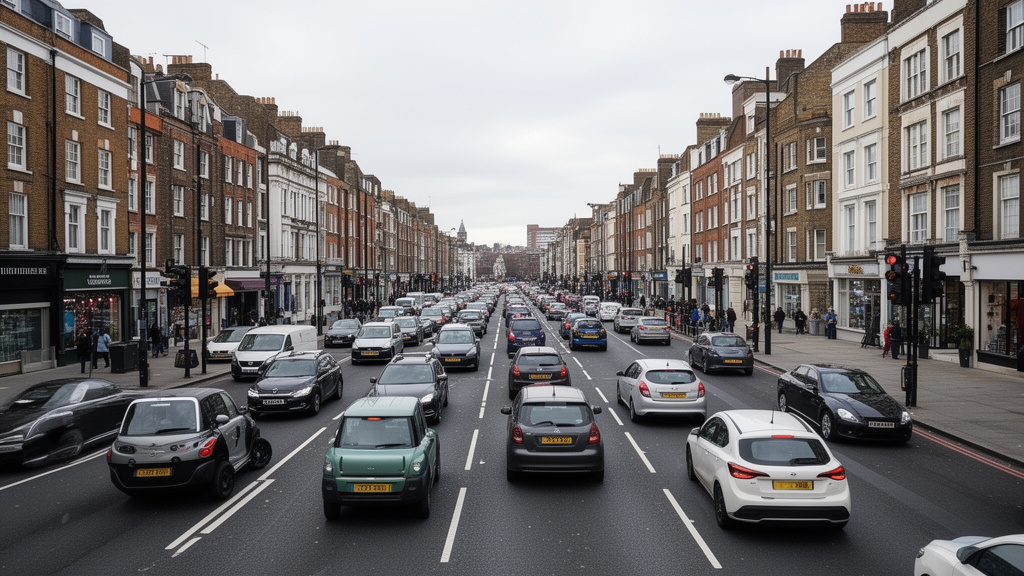
The London Borough of Hammersmith & Fulham has officially launched a stringent regulatory framework aimed at ending the disruptive gridlock caused by uncoordinated utility roadworks. Under the new mandate, utility companies and private contractors are now strictly prohibited from carrying out non-emergency roadworks on major traffic routes during morning and evening peak hours. This aggressive move, designed to reclaim road capacity for residents and commuters, marks a significant shift in how London boroughs manage the competing demands of utility infrastructure upgrades and traffic flow. By forcing a ‘clear roads’ policy during the most critical times of day, the council aims to drastically improve air quality and daily commute reliability across one of London’s busiest transit zones.
Key Highlights
- Peak Hour Blackout: Utility works are banned on major traffic routes between 07:00–10:00 and 16:00–19:00, minimizing impact on peak congestion.
- Fine Reinvestment: All generated financial penalties from non-compliance are legally earmarked specifically for pothole repairs and the installation of smart traffic-reduction technology.
- Enhanced Accountability: Contractors must now provide more granular, real-time data regarding their work schedules to gain permit approval.
- Environmental Focus: By reducing stationary, idling traffic during rush hour, the council projects a measurable reduction in localized carbon emissions and particulate matter.
Reclaiming the Road: The Mechanics of H&F’s New Policy
The implementation of these new regulations represents a pivotal moment in municipal urban planning. For decades, the ‘dig once’ principle—the idea that multiple utility companies should coordinate their road-cutting activities—has been a goal, but rarely a reality. Hammersmith & Fulham’s new policy moves beyond simple coordination, shifting toward a punitive-yet-constructive enforcement model that holds utility providers directly accountable for the economic and environmental costs of their presence on the street.
The Logic Behind the Peak-Hour Ban
Infrastructure maintenance is unavoidable, but the timing of these works has long been a source of public frustration. By restricting access to arterial routes during the 07:00–10:00 and 16:00–19:00 windows, the council is effectively removing the single largest contributor to unpredictable, non-incident-related traffic congestion. This policy forces utility companies to schedule their works during off-peak hours, often requiring them to move to night-shift operations. While this increases the operational complexity for these firms, the council maintains that the public interest in efficient transport networks outweighs the inconvenience to private contractors.
Funding the Future: The Financial Feedback Loop
The economic strategy behind this policy is notable for its circular nature. Rather than allowing fine revenue to disappear into a general council budget, Hammersmith & Fulham has created a closed-loop system where the penalties paid by utility companies for delaying traffic or overstaying their permit windows are directly funneled into physical infrastructure improvements. Specifically, these funds are ring-fenced for two critical areas: the rapid repair of potholes and the deployment of advanced traffic-reduction technology. This creates a direct incentive for the council to enforce the rules and a visible benefit for the taxpaying public, who will see their local road quality improve directly as a result of contractor negligence.
Technological Oversight: The Data-Driven Approach
The ‘smart traffic-reduction technology’ mentioned in the council’s roadmap is more than just buzzwords. H&F is investing in AI-driven traffic monitoring systems that can detect congestion hotspots in real-time. By integrating these systems with the permit-management software, the council can dynamically adjust traffic light timings and identify exactly which roadworks are causing the most significant delays. This digital twin approach allows for a more surgical application of roadworks bans, ensuring that while the rules are strict, they remain responsive to actual traffic conditions rather than adhering to rigid, potentially inefficient schedules.
Utility Companies Under Pressure
Utility providers, including water, gas, and broadband infrastructure firms, are now facing a significantly more rigorous permit application process. To obtain a permit for high-traffic routes, contractors must demonstrate that their work cannot be delayed or performed off-peak. This has led to a noticeable friction point between private sector efficiency and public sector traffic management. However, H&F’s administration argues that this friction is necessary to force the industry to modernize its operational logistics. By mandating higher standards for permit approval, the borough is effectively compelling companies to better manage their supply chains and workforce availability.
The Environmental Dividend
Beyond the frustration of sitting in traffic, idling engines contribute significantly to the borough’s air quality issues. Transport for London (TfL) has long struggled with pollution ‘canyons’ in high-density areas. By smoothing out traffic flow and reducing the start-stop nature of congestion caused by roadworks, Hammersmith & Fulham expects to see a decrease in tailpipe emissions. This policy aligns with the broader London-wide push toward cleaner air, proving that municipal traffic management is a vital component of environmental health policy.
Future Implications: Will This Model Scale?
The question now facing other London boroughs is whether the H&F approach is scalable. If this model succeeds in drastically reducing congestion and improving road conditions through fine-funded maintenance, it will likely become the blueprint for transport authorities across the UK. The strategy turns a perennial problem—construction traffic—into a financial and environmental asset, creating a system that balances infrastructure needs with the daily requirements of a functional, modern city.
FAQ: People Also Ask
Q: What happens if there is an emergency gas leak or water pipe burst during peak hours?
A: The new regulations include strict exemptions for genuine emergency works that pose an immediate risk to public safety or infrastructure. However, contractors must prove the ’emergency’ status to council inspectors, and documentation is subject to post-work audit to prevent abuse of this exemption.
Q: Are these fines high enough to change the behavior of large utility companies?
A: The fine structure is set at a level high enough to create a material impact on the project’s bottom line. By ensuring the revenue is specifically used for pothole repairs, the council is effectively weaponizing the cost of non-compliance against the utility companies.
Q: How does the public know if the money is actually being spent on pothole repairs?
A: The council has committed to a transparency initiative, pledging to publish annual reports detailing the revenue generated from roadwork fines and the specific locations and projects where that funding was deployed.
Q: Does this apply to all roads in the borough?
*A: The rules primarily target major traffic routes and arterial roads where utility works cause the most significant congestion. Local residential streets are subject to different permit criteria based on traffic volume.